
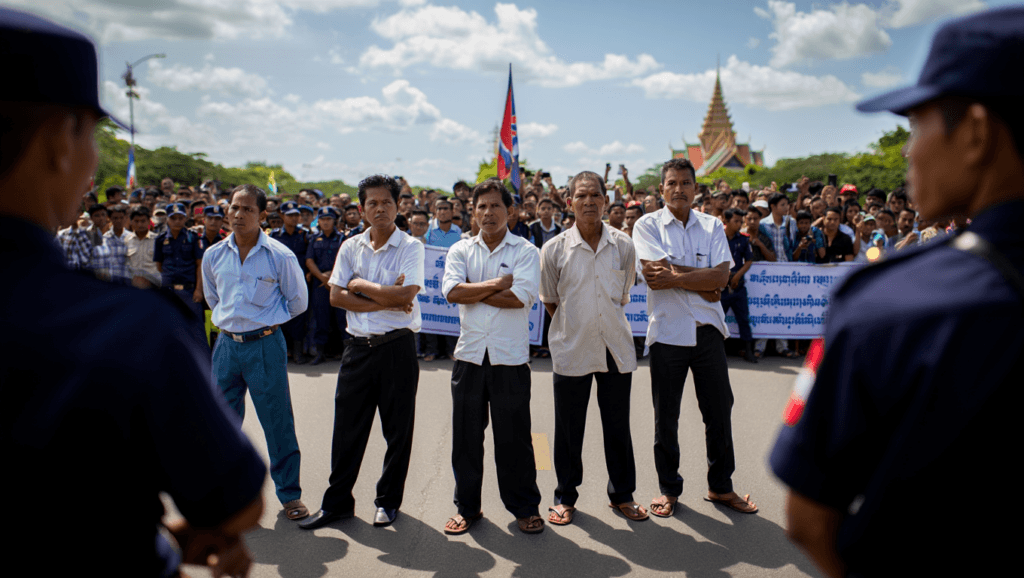
Community representatives from across Cambodia are facing intimidation and harassment for peacefully exercising their right to petition the government during the COVID-19 crisis.
On April 28, 2020, more than 30 representatives from over 140 communities gathered in Phnom Penh to submit a petition calling for urgent government support for vulnerable communities affected by the pandemic. Instead of being heard, these representatives were arbitrarily detained for more than seven hours, interrogated, and subjected to intimidation by authorities.
The petition contained life-saving requests, including:
During the submission process, community representatives were repeatedly questioned about who was “behind” the petition, who authored it, and whether the problems raised were genuine. Authorities focused heavily on the personal financial situations of representatives, particularly their microfinance debts, with some individuals being forced to provide proof of their loans.
At least two representatives were later summoned and harassed again by local authorities after returning to their communities.
This treatment is deeply concerning. It reflects a profound mistrust of grassroots communities who have, for decades, peacefully advocated for their rights — particularly around land, housing, and livelihoods. Such actions directly contradict repeated public assurances that communities have the right to conduct lawful activities without interference.
On the morning of April 28, representatives were first prevented from submitting the petition to the Council of Ministers. They were redirected to the Prime Minister’s Cabinet, where officials refused to accept the petition because it was addressed to the Council of Ministers. Copies were eventually submitted to the Ministry of Health and the Ministry of Economy and Finance.
Later that afternoon, nine community representatives were summoned to the Daun Penh District Office, where they were detained until late at night. They were denied permission to leave, provided with no legal justification for their detention, and interrogated using techniques more commonly applied to criminal suspects than peaceful petitioners. Some were ordered to unlock their mobile phones and hand them over to authorities.
Before being released, representatives were coerced into thumb-printing documents that seek to restrict their right to continue advocating on behalf of their communities.
These representatives came to Phnom Penh in good faith, with the sole intention of informing the government about the urgent realities facing tens of thousands of families during the COVID-19 pandemic. They did not demand anything beyond having their concerns considered as part of the national response to the crisis.
They should have been welcomed and treated with dignity.
We strongly condemn the harassment, detention, and intimidation of community representatives. Such actions undermine fundamental rights to freedom of expression and peaceful participation, particularly at a time when cooperation and trust between communities and authorities are essential to protecting public health.
We call on the Cambodian authorities to:
Signed,
(Full list of 140+ communities, unions, and civil society organizations)
Your support helps food and service workers organise, defend their rights, and improve working conditions through solidarity and collective power.